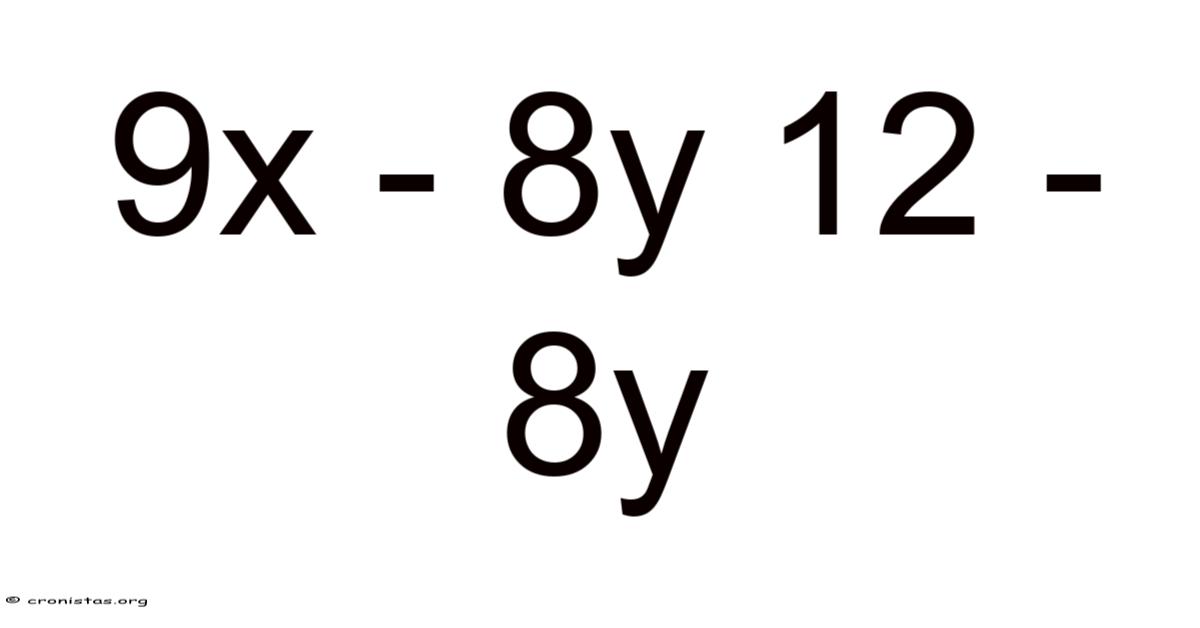
How to Solve 9x - 8y = 12 - 8y (And What It Actually Teaches You About Algebra)
You've probably seen it. A math problem stares back at you from the page — something like 9x - 8y = 12 - 8y — and your first instinct is to panic. In practice, two variables, two sides, a bunch of symbols. Consider this: it looks harder than it is. I promise.
Here's the thing: this equation is one of those problems that looks complicated on the surface but collapses into something beautifully simple once you know what to do. And the process of getting there? So it teaches you more about algebra than most textbook chapters do. Let's walk through it Still holds up..
What Does 9x - 8y = 12 - 8y Actually Mean?
Before we touch a single number, let's talk about what this equation is saying. On the flip side, on the left side, you've got 9x minus 8y. It's a linear equation with two variables — x and y. On the right, you've got 12 minus 8y.
This is the bit that actually matters in practice.
The goal is to find out what values of x and y make both sides equal. That's it. That's the whole game.
Linear Equations with Two Variables
A linear equation in two variables describes a relationship between x and y. Worth adding: normally, when you have two variables and one equation, you'd expect infinitely many solutions — a whole line of (x, y) pairs that work. Think of it like a balance: You've got many ways worth knowing here.
But sometimes — and this is the interesting part — the equation tells you something unexpected. Sometimes one of the variables just... disappears.
Why This Equation Is Special
Look at both sides of 9x - 8y = 12 - 8y. Notice anything?
Both sides have a -8y term. That's not a coincidence — it's a clue. Identical. On the flip side, same coefficient, same variable, same sign. And it's the key to everything that follows It's one of those things that adds up..
How to Solve 9x - 8y = 12 - 8y Step by Step
Let's break this down carefully. No shortcuts, no skipped steps Small thing, real impact..
Step 1: Get the Variable Terms on One Side
The first move — and honestly the most important one — is to eliminate the repeated term. Since -8y appears on both sides, we can add 8y to each side to cancel it out.
9x - 8y + 8y = 12 - 8y + 8y
On the left, -8y and +8y cancel each other. On the right, the same thing happens. What's left?
9x = 12
That's it. The y is gone Worth knowing..
Step 2: Solve for x
Now you've got a straightforward one-variable equation. Divide both sides by 9:
x = 12 / 9
Simplify the fraction:
x = 4/3
So x = 4/3 (or approximately 1.33 if you prefer decimals) That alone is useful..
Step 3: What About y?
Here's where people get tripped up. That said, **y can be anything. Day to day, ** Any real number. Since the y terms canceled out completely, y never constrained the equation. It was a free variable from the start.
That means the solution isn't a single point. It's a vertical line on the coordinate plane where x always equals 4/3, and y takes on every possible value.
Some solutions include:
- (4/3, 0)
- (4/3, 5)
- (4/3, -12)
- (4/3, 1000)
Plug any of these into the original equation and both sides balance. Every time.
Why Does Y Disappear? The Intuition Behind It
This is the part most algebra classes rush through, and it's a shame — because it's genuinely interesting.
When a variable cancels out of an equation, it means that variable was never really part of the constraint. The equation wasn't telling you anything about y. It was only telling you about x.
Think of it like a recipe that says "add salt to taste.Day to day, " The amount of salt doesn't change the outcome of the dish — it's irrelevant to the final result. In 9x - 8y = 12 - 8y, y is the salt. It shows up on both sides in equal amounts, so it contributes nothing to the relationship between the two sides.
What This Tells You Graphically
In a standard x-y coordinate plane:
- A normal two-variable linear equation (like 2x + 3y = 6) gives you a slanted line.
- When y cancels and you're left with x = a constant, you get a vertical line.
- If x had canceled instead, you'd get a horizontal line (y = some constant).
The vertical line x = 4/3 passes through every point where x is 4/3, regardless of y. It's a line that goes straight up and down, crossing the x-axis at exactly one spot Nothing fancy..
Common Mistakes When Solving Equations Like This
Mistake 1: Forgetting to Apply the Operation to Both Sides
This is the classic algebra error. The equation is a balance — whatever you do to one side, you must do to the other. You subtract 8y from the left but forget to add it to the right (or vice versa). Always.
Mistake 2: Thinking "No Y Solution" Means No Solution
When y cancels and you're left with a true statement (or a valid equation in x), that doesn't mean the problem has no answer. In real terms, it means y is unrestricted. The equation has infinitely many solutions, not zero.
Mistake 3: Confusing "No Solution" with "Infinite Solutions"
These are opposites, and students mix them up constantly Small thing, real impact..
- If the variable cancels and you get something false (like 0 = 5), there is no solution.
- If the variable cancels and you get something true (like 9x = 12, which you can solve), there are infinitely many solutions (because y is free).
- If you get a specific value for both x and y, there is exactly one solution.
Extending the Idea to Systems of Equations
When you encounter a single equation like
[ 9x-8y=12-8y, ]
the cancellation of (y) tells you that the equation is really a constraint on (x) alone.
If you later pair this equation with another linear equation, the outcome depends on how the second equation treats (y).
| Second equation | What happens? | Geometric picture |
|---|---|---|
| (2x+5y=7) | Substitute (x=\frac43) → (2! | |
| (x=\frac43) | Both equations describe the same vertical line. | |
| (x=2) | The vertical lines are parallel and distinct. Practically speaking, | The lines coincide – infinitely many points satisfy both. Also, \left(\frac43\right)+5y=7) → (y=\frac{13}{15}). Even so, |
Thus, recognizing that a variable has vanished helps you anticipate the nature of the solution set before you even start solving the second equation.
Checking Your Work Quickly
A fast sanity check is to plug a couple of random (y)-values into the original equation after you have solved for (x).
- Choose any two numbers for (y), say (y=3) and (y=-7).
- Compute the left‑hand side and right‑hand side using (x=\frac43).
[ \begin{aligned} \text{LHS}&=9!\left(\frac43\right)-8(3)=12-24=-12,\ \text{RHS}&=12-8(3)=12-24=-12. \end{aligned} ]
[ \begin{aligned} \text{LHS}&=9!\left(\frac43\right)-8(-7)=12+56=68,\ \text{RHS}&=12-8(-7)=12+56=68. \end{aligned} ]
Both pairs balance, confirming that the vertical line (x=\frac43) indeed satisfies the original equation for any (y).
Real‑World Interpretation
Imagine a scenario where a company’s profit (P) depends on the number of units produced (x) and the advertising spend (y):
[ P = 9x - 8y. ]
If the market imposes a fixed revenue target of (12) regardless of advertising, the condition becomes
[ 9x - 8y = 12 - 8y. ]
Cancelling the (-8y) terms shows that the profit target forces production to a specific level (x=\frac43) (in thousands of units). The advertising budget can be anything—higher spend does not affect the required production because its effect cancels out on both sides of the equation Took long enough..
Quick Reference Cheat‑Sheet
| Situation | Variable cancels? | Result |
|---|---|---|
| True numeric statement (e.g.Now, , (5=5)) | Yes, both sides become identical | All real numbers for the remaining variable(s) – infinitely many solutions. Still, |
| False numeric statement (e. Practically speaking, g. On the flip side, , (2=7)) | Yes, but the remaining statement is impossible | No solution. |
| A solvable equation in the remaining variable (e.g., (9x=12)) | Yes, leaving a condition on the other variable | Infinitely many solutions – the free variable can be any real number. |
| No cancellation | No | Solve normally; you’ll typically get a single ordered pair. |
Conclusion
When a variable disappears from a linear equation, it reveals that the equation does not restrict that variable at all. In the case of (9x-8y=12-8y), the cancellation of (y) leaves the simple condition (x=\frac43), which geometrically is a vertical line extending infinitely in the (y)-direction.
Understanding this behavior helps you avoid common pitfalls—mistaking “(y) cancels” for “no answer”—and equips you to handle more complex systems with confidence. Remember:
- Cancellation ≠ No solution.
- A true statement after cancellation signals infinitely many solutions.
- Always verify by substituting a couple of arbitrary values for the free variable.
With these insights, you can quickly interpret, solve, and graph equations where one variable seems to vanish, turning a potentially confusing algebraic moment into a clear, visual picture of the solution set.
