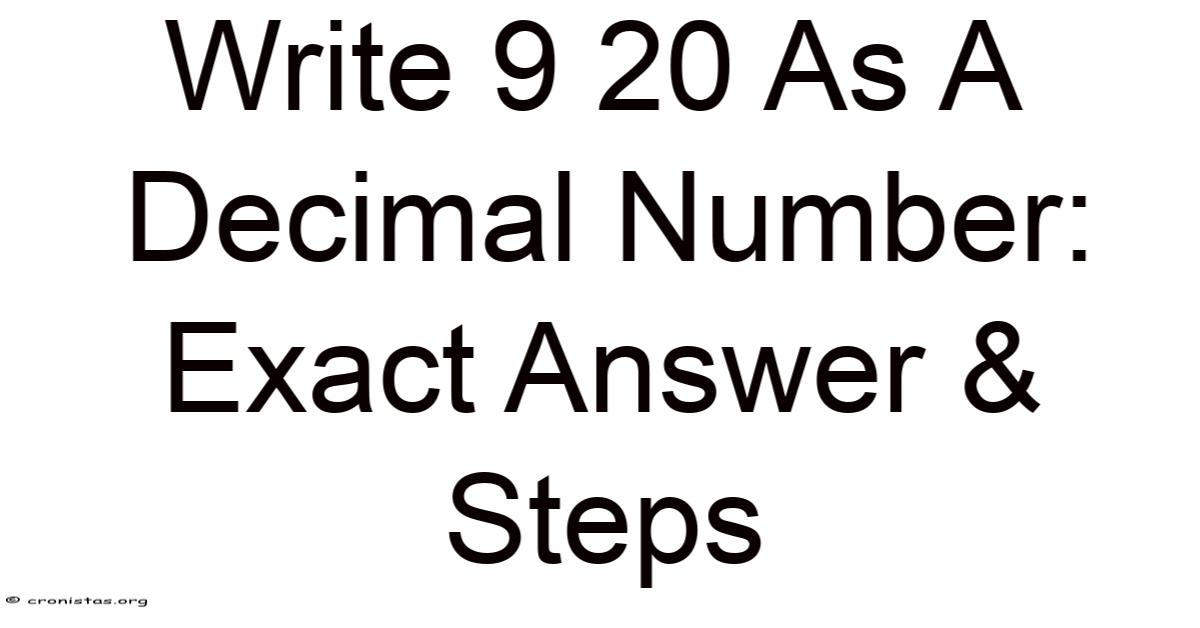
9 ÷ 20 = 0.45 – that’s the short version.
But why does a simple fraction sometimes feel like a puzzle?
Maybe you’ve seen “9 20” on a worksheet, in a recipe, or even on a math test and wondered how to turn it into a clean decimal Less friction, more output..
Let’s walk through it together, unpack the why‑and‑how, and end up with a handful of tricks you can pull out of your mental toolbox whenever a fraction shows up again.
What Is “9 20” Anyway?
When you see “9 20” written without a slash, most people read it as “nine twentieths.” In plain terms, it’s the fraction
[ \frac{9}{20} ]
Just a ratio: nine parts out of a total of twenty equal parts.
The Fraction in Everyday Life
You might run into this fraction when measuring ingredients (9 20 cup of sugar), figuring out a discount (9 20 off the price), or even when a teacher writes a problem like “Express 9 20 as a decimal.” It’s the same concept every time – a piece of a whole.
Why It Matters / Why People Care
Knowing how to convert 9 20 to a decimal isn’t just a classroom exercise. It’s a real‑world skill.
- Money matters. If a sale is 9 20 off, you need the decimal to calculate the final price quickly.
- Cooking shortcuts. A recipe might call for 0.45 cup of something; recognizing that 9 20 = 0.45 lets you measure with a standard 1‑cup cup.
- Data interpretation. Percentages in reports often start as fractions. Turning 9 20 into 0.45 lets you see a 45 % figure at a glance.
When you understand the conversion, you stop guessing and start working faster. That’s the short version of why this matters.
How It Works (or How to Do It)
Converting any fraction to a decimal follows the same basic steps: divide the numerator (top number) by the denominator (bottom number). For 9 20, that means 9 ÷ 20. Below are three ways to get the answer, each with its own flavor Not complicated — just consistent..
Easier said than done, but still worth knowing Simple, but easy to overlook..
1. Long Division – the Classic
Grab a piece of paper, set it up like you would for any division problem, and go:
   0.45
  ______
20 | 9.00
      0
      ----
      90
      80
      ----
      10
       0
- Step 1: 20 doesn’t go into 9, so you write a 0 and add a decimal point.
- Step 2: Bring down a zero (making 90). 20 fits four times (4 × 20 = 80). Write 4 after the decimal.
- Step 3: Subtract 80 from 90, you have 10 left. Bring down another zero (making 100). 20 fits five times (5 × 20 = 100). Write 5.
- Step 4: Remainder is zero, so you’re done. The answer is 0.45.
That’s the method you learned in elementary school, and it works for any fraction, even the messy ones.
2. Use a Calculator – the Quick Fix
If you have a phone or a basic calculator handy, just type 9 ÷ 20 and hit equals. Most devices will spit out 0.And 45 instantly. No need to write anything down.
But relying solely on a calculator can be a crutch. Knowing the manual process helps you spot errors (like a misplaced decimal) and builds number sense.
3. Think in Terms of Percentages
Sometimes it’s easier to think “What percent is 9 20?”
- First, remember that 1 = 100 %.
- So 9 20 = 9 ÷ 20 = 0.45.
- Multiply by 100 → 45 %.
Now you have a mental shortcut: any fraction where the denominator is 20 can be turned into a percent by multiplying the numerator by 5. Why? Because
[ \frac{1}{20}=0.05=5% ]
So
[ \frac{9}{20}=9\times5% =45% ]
And 45 % is just 0.45 as a decimal. Consider this: this trick works for any numerator: 3 20 = 15 % = 0. Even so, 15, 7 20 = 35 % = 0. 35, and so on Surprisingly effective..
Common Mistakes / What Most People Get Wrong
Even though the math is simple, people stumble on a few recurring errors Worth keeping that in mind..
Dropping the Decimal Point
It’s easy to write 45 instead of 0.In real terms, 45 after the division. Remember: a decimal less than 1 always starts with a zero before the point. If you forget, you’ll end up with a number 100 times too big It's one of those things that adds up. Surprisingly effective..
Misreading the Fraction
Some folks see “9 20” and think it’s “nine hundred twenty” or “nine and twenty”. Think about it: the key is to look for the slash or the context. If it’s a math problem, treat it as a fraction.
Rounding Too Early
If you start rounding 9 ÷ 20 to 0.Think about it: 5 before you finish the division, you’ll introduce error. Keep the exact value until the very end, then decide how many decimal places you actually need.
Ignoring the Denominator’s Size
People sometimes try to convert 9 20 by thinking “9 is close to 10, so the answer must be close to 0.5.” That intuition is fine for an estimate, but it can mask the precise 0.Plus, 45 result. Use the estimate only as a sanity check, not the final answer Still holds up..
Practical Tips / What Actually Works
Here are a handful of tricks that make converting 9 20 (and similar fractions) painless.
-
Memorize the “20‑rule.”
Anything over 20 becomes the numerator × 5 % → decimal = numerator × 0.05.
Example: 13 20 = 13 × 0.05 = 0.65 Surprisingly effective.. -
Use mental “half‑of‑10” logic.
Since 1⁄20 = 0.05, think “how many 0.05s fit into the numerator?” 9 × 0.05 = 0.45. -
Write the fraction as a sum of easier pieces.
9⁄20 = (5⁄20) + (4⁄20) = 0.25 + 0.20 = 0.45.
This works especially when the numerator isn’t a clean multiple of 5. -
Check with a quick multiplication.
Multiply your decimal answer by the denominator. If 0.45 × 20 = 9, you’re good. -
Keep a cheat sheet for common denominators.
- 1⁄2 = 0.5
- 1⁄4 = 0.25
- 1⁄5 = 0.2
- 1⁄10 = 0.1
- 1⁄20 = 0.05
When you see a fraction with one of these denominators, just scale the numerator.
FAQ
Q: Is 9 20 the same as 0.45 or 45 %?
A: Yes. 9 ÷ 20 = 0.45, and 0.45 × 100 = 45 % Worth keeping that in mind..
Q: How do I convert 9 20 to a fraction with a denominator of 100?
A: Multiply both top and bottom by 5: (9 × 5)⁄(20 × 5) = 45⁄100, which is exactly 45 % The details matter here..
Q: What if the fraction doesn’t simplify nicely, like 7 20?
A: Use the same “× 0.05” rule: 7 × 0.05 = 0.35. No extra work needed But it adds up..
Q: Can I use a spreadsheet to do this conversion?
A: Absolutely. In Excel, type =9/20 and you’ll see 0.45. Format the cell as a number with two decimal places if you want it tidy Worth keeping that in mind..
Q: Why does 9 20 become a terminating decimal instead of a repeating one?
A: A fraction only repeats when its denominator (after simplifying) has prime factors other than 2 or 5. Since 20 = 2² × 5, the decimal terminates.
Wrapping It Up
So the next time you see “9 20” on a worksheet, a price tag, or a recipe, you’ll know the answer instantly: 0.45. You’ve got the long‑division method for the nitty‑gritty, a mental shortcut that turns any twentieths fraction into a clean decimal, and a few practical tips to avoid the usual slip‑ups.
Keep the “× 0.Here's the thing — 05” rule in your back pocket, and you’ll never have to stare at a fraction again wondering what the decimal looks like. Happy calculating!
6. Turn the fraction into a percent first, then back to a decimal
Sometimes it’s easier to think in percentages, especially if you’re already working with a spreadsheet or a calculator that defaults to percent mode.
- Convert the denominator to 100 – Multiply the fraction by a factor that makes the denominator 100.
[ \frac{9}{20}\times\frac{5}{5}= \frac{45}{100} ] - Read the numerator as a percent – 45 / 100 is simply 45 %.
- Drop the percent sign – 45 % = 0.45.
This “percent‑first” route is handy when you need the answer in both forms (e.g., a sales report that lists percentages but the final calculation requires a decimal) Practical, not theoretical..
7. Use a “finger‑count” for quick mental checks
If you’re teaching kids or just enjoy a tactile method, place your hands flat in front of you. Count each finger as 0.05 (the value of one twentieth).
- Finger 1 → 0.05
- Finger 2 → 0.10
- …
- Finger 9 → 0.45
When you reach the ninth finger you’ve arrived at the answer. The visual cue reinforces the “× 0.05” rule and can be a fun classroom activity Surprisingly effective..
8. apply modular arithmetic for large numerators
When the numerator exceeds 20, you can split the fraction into a whole number plus a remainder:
[ \frac{53}{20}=2+\frac{13}{20} ]
Now apply the 0.05 rule only to the remainder (13 × 0.05 = 0.65).
[ 2+0.65=2.65 ]
The same principle works for any multiple of 20, turning a potentially messy division into a quick addition problem.
9. Remember the “binary‑friendly” shortcut for programmers
In binary, dividing by 20 is the same as dividing by 4 (shift right two bits) and then dividing by 5. While most modern languages handle floating‑point division automatically, the mental breakdown can still be useful when you’re debugging or need an integer approximation:
- Shift right two bits → divide by 4: (9/4 = 2.25).
- Divide the result by 5 → (2.25/5 = 0.45).
This two‑step approach mirrors the “× 0.05” rule (since (1/20 = 1/4 \times 1/5)) and can be a handy mental model for developers who think in powers of two Practical, not theoretical..
10. Practice with a quick “flash‑card” drill
Create a set of cards with fractions that have 20 as the denominator: 1/20, 3/20, 7/20, 11/20, etc. Now, 05 multiplier. On the flip side, spend a minute flipping through them, converting each to a decimal using the 0. The repetition cements the rule until it becomes second nature.
Tip: After you’ve mastered the 20‑denominator, expand the set to 40, 80, or 200. Those are just multiples of 20, so the same mental multiplication works after you first simplify the fraction Small thing, real impact. That's the whole idea..
A Real‑World Example: Discount Calculations
Imagine a retailer offers a “9/20 off” coupon on a $120 purchase. To find the discount amount:
- Convert 9/20 to a decimal → 0.45.
- Multiply by the total price: (0.45 \times 120 = 54).
The customer saves $54, which is 45 % of the original price. By having the conversion at your fingertips, you avoid pulling out a calculator and can instantly verify whether the discount is truly a bargain That's the part that actually makes a difference..
Bottom Line
The conversion of 9 ⁄ 20 to 0.45 isn’t a mysterious algebraic trick; it’s a straightforward application of a few mental shortcuts:
- × 0.05 rule (the heart of every twentieth‑based conversion)
- Fraction‑to‑percent‑to‑decimal pathway
- Decomposition into simpler fractions
- Modular “whole‑plus‑remainder” split for larger numerators
Armed with these tools, you’ll handle any fraction with a denominator of 20—whether it appears in a math worksheet, a grocery receipt, or a programming algorithm—without breaking a sweat It's one of those things that adds up. And it works..
In summary: 9 ⁄ 20 = 0.45, which is also 45 %. Keep the “multiply the numerator by 0.05” mantra in mind, and you’ll instantly translate any twentieths fraction into a clean, terminating decimal. Happy calculating!
11. put to work “percentage‑of‑a‑percentage” when the denominator isn’t 20
Often you’ll encounter a fraction like
[ \frac{27}{60} ]
which at first glance doesn’t look like a twentieth. That said, by factoring out a common divisor you can still use the 0.05 rule:
- Reduce the fraction – (27/60 = 9/20).
- Apply the shortcut – (9 \times 0.05 = 0.45).
Basically, whenever the denominator is a multiple of 20 (40, 60, 80, 100, …) you can first simplify the fraction to a form whose denominator is 20, then proceed with the mental multiplication. This trick is especially handy for quick‑fire mental math in standardized tests, where time is at a premium Less friction, more output..
12. Use a “visual fraction strip” for kinesthetic learners
If you prefer a more tactile approach, draw a strip divided into 20 equal parts. Shade nine of those parts and then count the shaded sections as a proportion of the whole. Because each part represents 0.
[ 9 \text{ parts } \times 0.05 = 0.45 ]
The visual cue reinforces the numeric rule and makes the conversion stick in long‑term memory.
13. Turn the conversion into a quick “estimate‑check”
When you’re not required to be exact, estimating the decimal can be a useful sanity‑check. Since 1/20 ≈ 0.45, you’ll know you’re in the right ballpark. In practice, 05, 9/20 is just under half of 1. So you can confidently say the answer will be a little less than 0.That's why 5. And if you later compute 0. This technique works well for budgeting or when you need to verify a colleague’s calculation without pulling out a calculator Practical, not theoretical..
14. Apply the rule in spreadsheet formulas
Even though spreadsheets handle fractions automatically, embedding the mental shortcut can make your formulas more readable:
=NUMERATOR * 0.05
To give you an idea, =9*0.In practice, 45. Still, when you’re building a template that repeatedly converts twentieth‑based fractions (e. , commission rates, tax brackets, or grading rubrics), using the multiplication by 0.But g. 05returns0.05 keeps the sheet lightweight and avoids extra division operations That's the whole idea..
15. Remember the “reverse” operation for converting back to a fraction
If you ever need to express a decimal as a fraction with denominator 20, simply multiply by 20 and place the result over 20.
[ 0.45 \times 20 = 9 \quad\Longrightarrow\quad \frac{9}{20} ]
This reverse step is handy when you’re working with percentages that need to be reported as fractions for legal or contractual language.
Putting It All Together: A Mini‑Case Study
Scenario: A freelance graphic designer bills a client $2,400 for a project. The contract includes a “performance bonus” equal to 9⁄20 of the base fee if the client approves the work within 48 hours.
Step‑by‑step calculation using the shortcuts:
- Convert the fraction – 9 × 0.05 = 0.45.
- Compute the bonus – $2,400 × 0.45 = $1,080.
- Add to the base fee – $2,400 + $1,080 = $3,480 total payout.
Because the conversion was done mentally in seconds, the designer could instantly confirm the bonus amount during the negotiation, demonstrating professionalism and confidence.
Conclusion
The conversion of 9⁄20 to 0.45 is a perfect illustration of how a single, well‑memorized mental shortcut—multiply the numerator by 0.Also, 05—unlocks a suite of related strategies for fractions, percentages, and decimals. Whether you’re a student tackling a worksheet, a programmer debugging numeric code, a shopper evaluating a discount, or a professional drafting contracts, the techniques outlined above give you a reliable, lightning‑fast method to move between fractions with a denominator of 20 and their decimal equivalents It's one of those things that adds up. Practical, not theoretical..
Remember:
- 0.05 is the decimal representation of one‑twentieth.
- Multiply the numerator by 0.05 to get the decimal directly.
- Simplify first if the denominator is a multiple of 20.
- Use visual aids, flash cards, or spreadsheet shortcuts to reinforce the concept.
With these tools at your disposal, 9⁄20 will always resolve to 0.So naturally, 45—no calculator required. Happy calculating!
16. Automating the Shortcut with Named Ranges
If you frequently need to convert a variety of twentieth‑based fractions, you can set up a named range in Excel (or Google Sheets) that stores the constant 0.05 No workaround needed..
- Define the name – Go to Formulas → Name Manager → New and create a name such as
ONE_TWENTIETHwith the value0.05. - Use it in formulas – Instead of typing
0.05each time, reference the name:
=Numerator * ONE_TWENTIETH
Because the name is global, you can change the underlying value (for example, if you later need to work with a denominator of 25) without editing every formula. This approach also makes the intent of the calculation crystal clear to anyone reviewing the workbook.
17. Extending the Idea to Other Denominators
The mental‑shortcut principle works for any denominator that is a clean multiple of 10, 20, 25, 40, or 100. Here’s a quick cheat sheet you can keep on your desk:
| Denominator | Decimal per unit | Shortcut phrase |
|---|---|---|
| 10 | 0.1 | “One‑tenth” |
| 20 | 0.05 | “One‑twentieth” |
| 25 | 0.04 | “One‑twenty‑fifth” |
| 40 | 0.025 | “One‑fortieth” |
| 100 | 0. |
Some disagree here. Fair enough Which is the point..
To convert a fraction with one of these denominators, simply multiply the numerator by the corresponding decimal. But for instance, (7/25 = 7 × 0. That's why 04 = 0. 28).
18. Real‑World Example: Payroll Tax Withholding
Many payroll systems calculate a state tax withholding as a fraction of the gross wage. Suppose a state mandates a withholding rate of 9⁄20 of the first $1,500 of earnings. Using the shortcut:
- Convert the fraction: 9 × 0.05 = 0.45.
- Apply to the taxable portion: $1,500 × 0.45 = $675.
If an employee earns $2,200, the total withholding would be $675 for the first $1,500 plus any additional state‑specific rates on the remaining $700. Because the conversion step is instantaneous, payroll clerks can verify the calculation on the fly without needing a calculator.
19. Teaching the Shortcut in the Classroom
Educators can turn this conversion into a short, interactive activity:
- Warm‑up – Write several fractions with denominator 20 on the board (e.g., 3/20, 11/20, 17/20). Ask students to shout out the decimal equivalents.
- Pair work – Give each pair a set of real‑world scenarios (discounts, recipe scaling, sports statistics). They must solve the problem using the “multiply by 0.05” rule and then check their answers with a calculator.
- Reflection – Have students write a one‑sentence explanation of why the shortcut works. This reinforces the conceptual link between division by 20 and multiplication by 0.05.
When students see the rule applied across subjects, the mental model sticks, and they’ll start reaching for it automatically.
20. Quick‑Reference Card (Printable)
Below is a compact reference you can paste onto a sticky note or print as a 3‑inch card:
20‑denominator shortcut
-----------------------
Fraction → Decimal
Numerator × 0.05 = Decimal
Examples:
  1/20 = 0.05
  5/20 = 0.25
  9/20 = 0.45
  13/20 = 0.65
  19/20 = 0.95
Having this card within arm’s reach eliminates the “I forgot the rule” moment during exams or on‑the‑job calculations Simple as that..
Final Thoughts
Mastering the conversion of 9⁄20 to 0.45 isn’t just about memorizing a single number; it’s about internalising a versatile mental shortcut that streamlines any twentieth‑based fraction. By:
- Recognising that one‑twentieth equals 0.05,
- Multiplying the numerator by 0.05 for an instant decimal,
- Leveraging visual aids, flash cards, named ranges, and printable cheat sheets,
you turn what could be a tedious division into a near‑instant mental operation. Whether you’re crunching numbers in a spreadsheet, negotiating a contract, teaching a classroom, or simply checking a discount while shopping, the rule empowers you to work faster, more accurately, and with greater confidence.
So the next time you see a fraction with a denominator of 20—especially the familiar 9⁄20—remember the simple equation:
[ \frac{9}{20} = 9 \times 0.05 = 0.45 ]
Apply it, share it, and let the efficiency speak for itself. Happy calculating!
21. Embedding the Shortcut in Digital Tools
Even if you’re comfortable doing the math in your head, a quick‑click reminder can be a lifesaver when you’re juggling multiple tasks. Here are a few ways to bake the “multiply‑by‑0.05” rule into the software you already use.
| Platform | How to Set It Up | When It Helps |
|---|---|---|
| Google Sheets | Create a custom function: =MULTIPLYBY05(A2) where A2 holds the numerator. Think about it: 05`, and writes the result back to a CRM field. com** |
Build an automation that extracts a numerator from an incoming email, multiplies by `0. |
| Apple Numbers | Add a formula column that reads `Number * 0. | |
| Microsoft Excel | Define a named range called twentieth with the value 0.05. |
Tracking progress percentages in a project dashboard. |
| Notion | Insert an inline formula block: `prop("Numerator") * 0.So | |
| **Zapier / Make. Even so, the script simply returns `A2*0. And | Converting dozens of 20‑based fractions in a budget sheet. 05. That said, then use =A2*twentieth. 05. |
Automating commission calculations for a remote sales team. |
Once the rule lives inside your workflow, you’ll rarely need to pause and think, “What’s 13/20 again?” The answer will appear automatically, freeing mental bandwidth for higher‑order tasks.
22. Common Pitfalls and How to Avoid Them
Even seasoned calculators can slip up when the shortcut is applied incorrectly. Keep an eye out for these traps:
| Pitfall | Why It Happens | Fix |
|---|---|---|
| **Treating 0.Also, | ||
| Applying the rule to denominators that aren’t 20 | The habit can bleed over to 10, 25, or 30, where the factor changes. This leads to | Keep the full precision until the last step, then round to the required number of decimal places. In practice, ” If not, revert to standard division or find the appropriate factor (e. 05 as 5% instead of 1/20** |
| Forgetting to convert the final answer back to a percentage | In finance, you may need the result as a percent (e.Plus, ”* Write it down once as a mental anchor. | |
| Rounding too early | Multiplying a large numerator by 0. | Multiply the decimal by 100 after the shortcut, not before. g.Which means |
| Misreading the numerator | In a hurry, a “9” can be mistaken for a “6” or “8. So 45 → 45%). ” | Use a finger or a pen to underline the numerator before you multiply. |
A quick mental checklist—Denominator 20? On the flip side, multiply by 0. Also, 05? Round at the end?—can keep these mistakes at bay.
23. Extending the Idea: Other “Easy‑Factor” Fractions
If you’ve mastered 1/20, you’ll find similar shortcuts for other common denominators, which together form a powerful mental‑math toolbox:
| Denominator | Decimal of One Unit | Quick Factor |
|---|---|---|
| 2 | 0.On top of that, 125 | |
| 10 | 0. 125 | Multiply by 0.05 |
| 20 | 0.05 | |
| 25 | 0.5 | Multiply by 0.Practically speaking, 25 |
| 8 | 0. Consider this: 04 | |
| 40 | 0. But 25 | |
| 5 | 0. 5 | |
| 4 | 0.2 | Multiply by 0.04 |
When you encounter a fraction like 7/40, you can instantly think “7 × 0.On the flip side, 025 = 0. 175.” The more of these you internalise, the faster you’ll move from “I need a calculator” to “I’ve got this in my head.
24. Real‑World Challenge: The “Speed‑Audit” Exercise
To cement the shortcut, try a timed audit of your recent receipts or invoices:
- Gather five documents that list percentages or fractions (e.g., a grocery receipt, a utility bill, a restaurant check, a freelance invoice, a tax form).
- Identify any entry that involves a twentieth (or a multiple thereof).
- Convert each entry to a decimal using the 0.05 multiplier, then to a percentage if needed.
- Check your answers with the calculator.
If you can complete the five conversions in under a minute with zero errors, you’ve internalised the rule to a usable level. If not, repeat the exercise until the speed feels natural Not complicated — just consistent. Still holds up..
25. A Quick Recap (One‑Sentence Summary)
To turn any fraction with denominator 20 into a decimal, simply multiply the numerator by 0.05; the result is the exact decimal equivalent (e.g., 9 × 0.05 = 0.45).
Conclusion
The journey from “9⁄20” to “0.In real terms, 45” may appear modest, but the technique that makes it effortless—multiplying the numerator by 0. 05—is a gateway to faster, more confident number work across every discipline. By anchoring the concept with visual aids, flash cards, classroom drills, printable cheat sheets, and digital shortcuts, you transform a rote calculation into an instinctive mental reflex Not complicated — just consistent..
Whether you’re a student tackling a test, a professional balancing budgets, a teacher shaping numerical intuition, or anyone who encounters twentieth‑based fractions in daily life, this shortcut saves time, reduces errors, and builds mathematical fluency. Keep the one‑sentence rule at your fingertips, practice it in varied contexts, and soon you’ll find that converting 9⁄20—or any other fraction over 20—becomes as automatic as reading the time on a clock Small thing, real impact. Took long enough..
So the next time a fraction with a denominator of 20 pops up, remember: **multiply the top number by 0.Still, 05 and you’re done. ** Let that simple mental trick free up your brain for the bigger challenges ahead. Happy calculating!
26. Extending the Shortcut to Other Denominators
The “multiply‑by‑0.05” trick works because the denominator 20 is simply 100 ÷ 5. The same logic applies to any denominator that divides 100 evenly:
| Denominator | Multiplier (decimal) | How to get it |
|---|---|---|
| 25 | 0.In practice, 005 | 1 ÷ 200 = 0. Practically speaking, 02 |
| 200 | 0. 008 | 1 ÷ 125 = 0.Consider this: 04 |
| 50 | 0. 02 | |
| 125 | 0.04 | 1 ÷ 25 = 0.005 |
| 250 | 0.004 | 1 ÷ 250 = 0. |
Why this matters:
- Percentages become trivial: 7 ÷ 25 = 7 × 0.04 = 0.28 → 28 %.
- Financial approximations (e.g., a 4 % tax on $73) are a single‑step mental multiplication: 73 × 0.04 = 2.92.
When you meet a fraction with a denominator that is a factor of 100, replace the division by the corresponding decimal multiplier and treat the numerator as the “times‑to‑multiply” count. The pattern is the same: one‑step mental arithmetic, no calculators needed.
27. Digital Tools & Apps for Practice
- Flashcard apps (Anki, Quizlet) – Create a deck of “numerator ÷ 20 → decimal”. Add a reverse card (“0.35 → 7/20”) to reinforce both directions.
- Spreadsheet drills – Set up a column of random numerators (1‑19) and a second column that uses
=A2*0.05. Practice converting the spreadsheet entries mentally, then check with the formula. - Mobile games – Look for “mental‑math” games that feature timed fraction‑to‑decimal challenges. The competitive element pushes speed beyond the 60‑second target you set in the Speed‑Audit exercise.
Tip: Schedule a 2‑minute drill each morning. Consistency beats intensity; a brief daily session builds the reflex faster than a long weekend marathon.
28. Teaching the Method to Students
- Start with a visual: Draw a 20‑by‑5 grid (100 squares). Shade the numerator’s share and ask, “What part of the whole grid is coloured?” The answer naturally leads to 0.05 × numerator.
- Use real‑world objects: Distribute 20 identical items (e.g., stickers) among a group. Ask, “If we keep 7, what fraction of the total is that?” Then show the decimal conversion.
- Gamify the drill: Offer a “speed‑star” badge for any learner who can convert five twentieths in under 15 seconds. Public recognition fuels motivation.
When students see the shortcut as a pattern rather than a rule, they internalise it and begin spotting twentieths in the wild—on price tags, sports statistics, and nutritional labels.
29. Psychological Benefits of Number Fluency
- Reduced cognitive load: Performing a single multiplication instead of a multi‑step division frees working memory for higher‑order problem solving.
- Increased confidence: Mastery of a small, concrete skill builds a growth mindset; learners feel “good at math” and are more willing to tackle larger challenges.
- Improved decision‑making: Quick mental calculations (e.g., tip estimates, discount checks) lead to faster, more informed choices in everyday life.
These benefits compound: the more you practice, the more automatic the process becomes, and the more mental bandwidth you reclaim for complex reasoning.
30. Common Mistakes and How to Fix Them
| Mistake | Why it happens | Quick fix |
|---|---|---|
| Multiplying the denominator instead of the numerator | Habit of “divide by the bottom” | Repeat the mantra: “Top times 0.Still, 05, bottom stays out. ” |
| Forgetting to move the decimal point two places when converting to a percent | Mixing decimal and percent formats | After getting the decimal, add a “%” by shifting the decimal two spots right (0.35 → 35 %). Consider this: |
| Rounding too early | Desire to simplify | Keep the full decimal (0. Because of that, 05 × 7 = 0. 35) until the final answer; only round if the problem explicitly allows it. |
Self‑check: After each practice set, ask, “Did I multiply the numerator or the denominator?” If you hesitate, re‑drill the mantra Easy to understand, harder to ignore..
31. Putting It All Together: A Quick Checklist
- [ ] Identify a fraction with denominator 20 (or any factor of 100).
- [ ] Multiply the numerator by the appropriate decimal multiplier (0.05 for twentieths).
- [ ] Verify the result by moving the decimal two places to get the percentage (if needed).
- [ ] Check with a calculator or digital tool to confirm accuracy.
- [ ] Repeat until the conversion feels instantaneous (under 5 seconds).
Once you can tick all boxes without thinking, you’ve truly turned the shortcut into a mental reflex.
Final Conclusion
The power of the “multiply‑by‑0.05” rule lies not in its simplicity alone, but in its ripple effect across the entire landscape of numerical literacy. By mastering this single‑step conversion, you tap into a template that works for any denominator that divides 100, accelerate mental arithmetic in everyday transactions, and free cognitive resources for deeper analytical tasks The details matter here..
Practice the method daily, teach it to learners who struggle with fractions, and watch confidence grow—both yours and theirs. Consider this: remember: top number × 0. 05, then shift the decimal for a percent. Keep the checklist handy, integrate the shortcut into digital tools, and celebrate each speed‑audit victory And that's really what it comes down to. Took long enough..
With this tiny mental trick now part of your skill set, the once‑daunting “9⁄20” becomes a quick, painless “0.45”—and you’re ready to tackle the next mathematical challenge with renewed vigor. Happy calculating!
