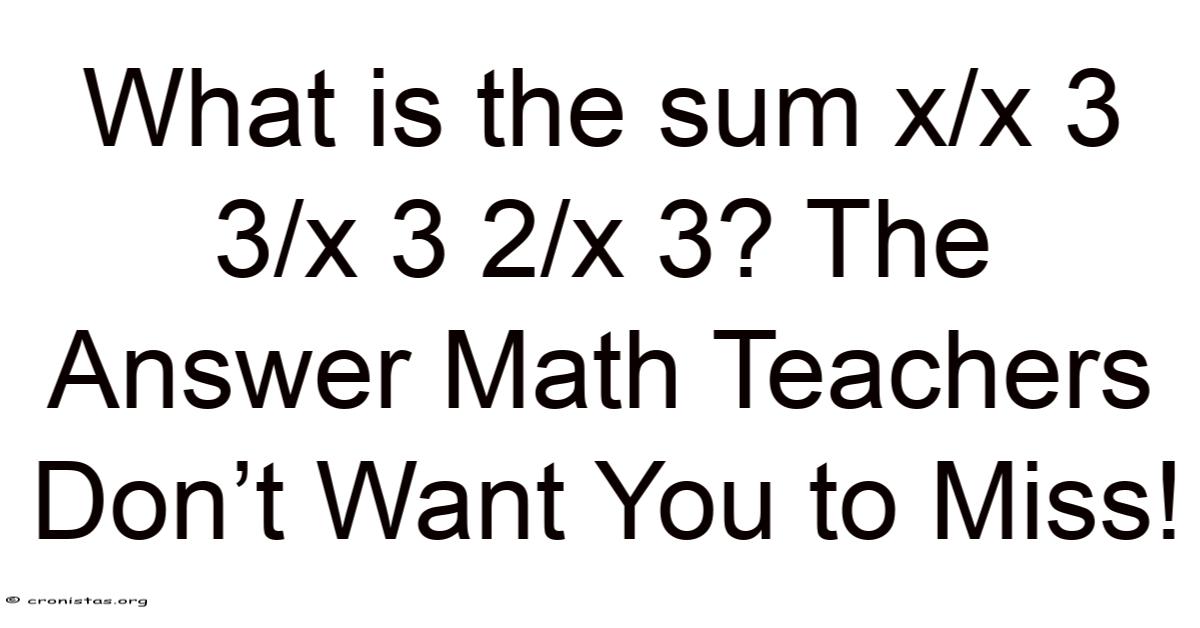
What’s the Sum of x/x³ + 3/x³ + 2/x³?
Ever stare at a jumble of fractions and wonder if there’s a shortcut? That’s the kind of algebraic puzzle that can trip you up in a quick test or a homework sheet. The expression x/x³ + 3/x³ + 2/x³ looks like a handful of numbers and a variable, but it’s actually a simple fraction in disguise. Let’s break it down, see why it matters, and walk through the steps so you can tackle similar problems with confidence And it works..
What Is the Expression?
When you see x/x³ + 3/x³ + 2/x³, you’re looking at three separate terms that all share the same denominator: x³. The first term, x/x³, simplifies to 1/x² because the x in the numerator cancels one x in the denominator. The other two terms, 3/x³ and 2/x³, stay as they are because they’re already in simplest form. So the whole expression is just a sum of fractions with a common denominator.
The “Common Denominator” Trick
The trick that makes this easy is noticing that the denominator x³ is the same in every term. When denominators match, you can combine the numerators directly:
x/x³ + 3/x³ + 2/x³ → (x + 3 + 2) / x³
That’s it: just add the numerators, keep the denominator, and you’re done. The result is (x + 5) / x³. If you want to simplify further, you can factor out an x from the numerator, but that only helps if you’re looking for a particular form That alone is useful..
Why It Matters / Why People Care
You might be thinking, “Is this really worth learning?” Absolutely. Algebraic manipulation is the backbone of higher math, physics, engineering, and even finance.
- Reduces clutter in equations, making them easier to read and solve.
- Saves time on exams and assignments.
- Prevents errors that come from carrying around unnecessary terms.
- Builds confidence for tackling more complex problems, like rationalizing denominators or solving equations with fractions.
If you’ve ever seen a math problem that looks like a wall of symbols and felt stuck, remember that the first step is often to look for patterns—like shared denominators Still holds up..
How It Works (Step by Step)
Let’s walk through the simplification process in detail, so you can see exactly what’s happening at each stage.
1. Identify the Denominators
Look at each term:
- x/x³ → denominator x³
- 3/x³ → denominator x³
- 2/x³ → denominator x³
All three share x³. That’s our common denominator.
2. Simplify Individual Terms (If Possible)
The first term can be reduced:
x/x³ = 1/x²
Because x/x³ = x / (x·x²) = 1 / x². The other two terms are already simplified.
3. Combine Over the Common Denominator
Now that every term is over x³, add the numerators:
(1/x²) + (3/x³) + (2/x³)
But notice 1/x² has a different denominator. To combine it, rewrite it with denominator x³:
1/x² = x/x³
Now we have:
x/x³ + 3/x³ + 2/x³
Add numerators:
(x + 3 + 2) / x³ = (x + 5) / x³
4. Simplify Further (Optional)
You can factor x out of the numerator if you want:
(x + 5) / x³ = (x(1 + 5/x)) / x³ = (1 + 5/x) / x²
But that’s usually unnecessary unless you need a specific form for a later step.
Common Mistakes / What Most People Get Wrong
-
Forgetting to Simplify the First Term
Many people skip the x/x³ = 1/x² step and try to combine everything directly. That leads to algebraic messiness And it works.. -
Misaligning Denominators
Mixing up x² and x³ can throw you off. Always rewrite everything with the same denominator before adding. -
Dropping the Variable
Some students mistakenly treat x as a constant and cancel it out too early, ending up with a numeric answer that’s wrong Most people skip this — try not to.. -
Over‑Simplifying
Turning (x + 5)/x³ into 1/x² + 5/x³ is technically correct but less useful if you need a single fraction Nothing fancy.. -
Ignoring Domain Restrictions
Remember that x cannot be zero because you can’t divide by zero. Always state that the expression is undefined at x = 0 Simple, but easy to overlook..
Practical Tips / What Actually Works
- Write Everything Down – Even if it looks repetitive, writing each step helps catch mistakes.
- Use Color Coding – Color the numerators one way and denominators another; the common denominator will pop out.
- Check Your Work – After simplifying, pick a random non‑zero x (like 2 or 3) and plug it back in to see if both sides match.
- Practice with Variations – Try x²/x³ + 4/x³ + 6/x³ or 5/x³ + 7/x³ + 9/x³. The same principle applies.
- Remember the “Common Denominator” Rule – It’s a lifesaver for adding, subtracting, or even multiplying fractions in many algebra problems.
FAQ
Q1: Can I combine the terms without simplifying x/x³ first?
A1: Yes, but you’ll need to rewrite x/x³ as x/x³ (which it already is) and then add. The simpler route is to reduce it to 1/x² and then adjust the denominator.
Q2: What if the denominators were different, like x² and x³?
A2: Find the least common denominator (LCD), which would be x³ in that case, and rewrite each term accordingly before adding.
Q3: Is the expression defined when x = 0?
A3: No. Any term with x in the denominator becomes undefined at x = 0, so the whole expression is undefined there.
Q4: Why not just leave the answer as 1/x² + 3/x³ + 2/x³?
A4: While that’s a correct representation, combining into a single fraction often simplifies further calculations, especially when you’re solving equations or integrating It's one of those things that adds up..
Q5: Does this technique work for more than three terms?
A5: Absolutely. As long as you can identify a common denominator, you can add any number of fractions in the same way.
Wrap‑Up
Simplifying x/x³ + 3/x³ + 2/x³ is a quick win in algebra. Spot the common denominator, reduce where you can, and add the numerators. The result, (x + 5)/x³, is tidy and ready for whatever comes next—whether that’s solving an equation, graphing a function, or just proving your math chops. Keep practicing these steps, and you’ll find that even the trickiest looking fractions become routine. Happy simplifying!
