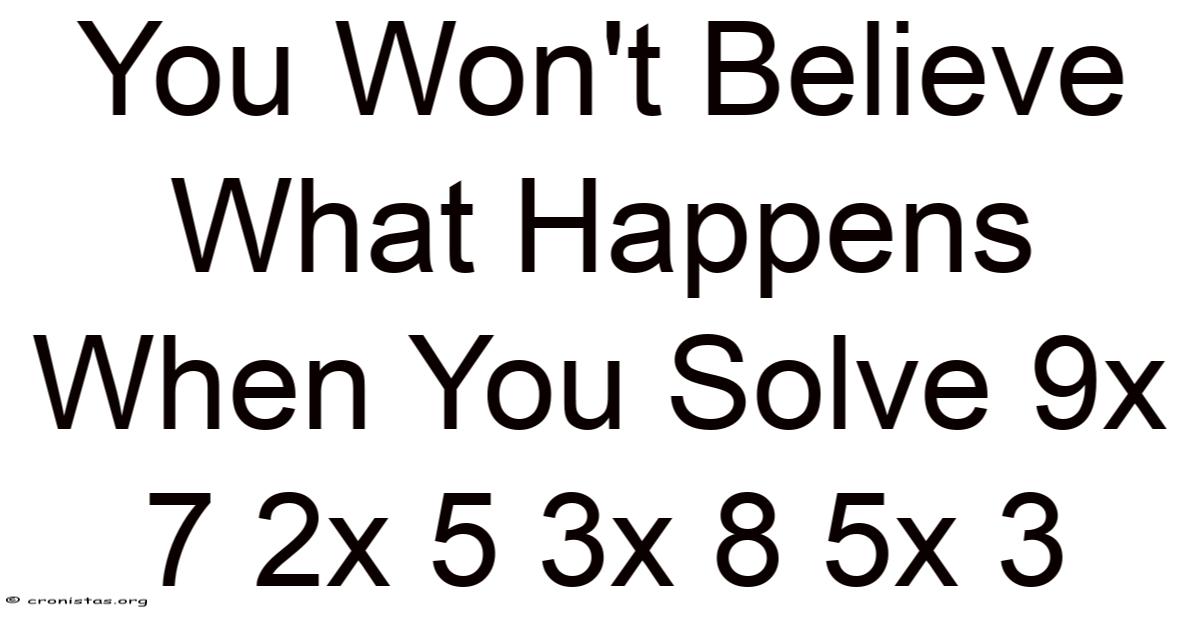
Ever stared at a string of numbers like “9x 7 2x 5 3x 8 5x 3” and wondered what on earth it’s trying to tell you?
You’re not alone. Worth adding: those little “x” symbols can be a quick shortcut for multiplication, a hidden code, or just a brain‑teaser that pops up on a worksheet. The short version is: if you treat each “x” as the multiplication sign, you’ve got a handful of simple products that, when you line them up, reveal a pattern worth knowing Simple, but easy to overlook..
This is the bit that actually matters in practice Easy to understand, harder to ignore..
Below, I break down what those numbers really mean, why they matter (especially if you’re a student, teacher, or anyone who loves a good numeric puzzle), and how to turn a confusing line of symbols into clear, bite‑size math you can use right away.
What Is “9x 7 2x 5 3x 8 5x 3”
At first glance it looks like a random mash‑up of digits and the letter “x”. In everyday math, that “x” most often stands for the multiplication operator. So the string actually represents four separate multiplication problems:
- 9 × 7
- 2 × 5
- 3 × 8
- 5 × 3
Put them together you get a list of four products: 63, 10, 24, and 15.
Why the spaces matter
If you type it into a calculator without spaces (“9x7 2x5 3x8 5x3”), most devices will choke because they expect a single expression. Adding a space—or a comma, semicolon, or line break—tells the brain (and the software) that each pair is its own little problem That's the part that actually makes a difference..
The “x” isn’t always multiplication
In algebra, “x” is also a variable. That’s why you’ll sometimes see “9x + 7” meaning “nine times the unknown plus seven”. In the pattern we’re dissecting, though, the context (numbers on either side, no plus or minus signs) screams “multiply”.
Why It Matters / Why People Care
For students, it’s a confidence booster
Multiplication tables are the backbone of elementary math. Even so, when a kid sees a string like this and can instantly say “63, 10, 24, 15,” they get a quick win. That little win builds confidence for tackling larger problems later on The details matter here..
Teachers love quick‑fire drills
A teacher can flash “9x 7 2x 5 3x 8 5x 3” on the board and have the class shout the answers in unison. It’s a fast way to check that everyone still remembers the times tables up to 9 × 9.
For puzzle lovers, it’s a stepping stone
Many brain‑teasers hide a message in the results. That’s the kind of “aha!**—but if you look at the digits instead (6‑3, 1‑0, 2‑4, 1‑5) you might spot a hidden shape or a code. That's why take the products we just got: 63, 10, 24, 15. Convert each to a letter (A = 1, B = 2, …) and you get **?” moment that keeps people coming back for more.
How It Works (or How to Do It)
Below is a step‑by‑step guide that works whether you’re solving it on paper, a calculator, or just in your head.
1. Separate the pairs
First, split the string wherever there’s a space (or any delimiter you prefer) That alone is useful..
9x7   → pair 1
2x5   → pair 2
3x8   → pair 3
5x3   → pair 4
2. Identify the operator
In each pair the “x” is the multiplication sign. If you ever see a “+”, “‑”, or “÷”, you’d handle those differently, but here it’s all multiplication But it adds up..
3. Multiply the numbers
Do the arithmetic.
| Pair | Calculation | Result |
|---|---|---|
| 9 × 7 | 9 × 7 = 63 | 63 |
| 2 × 5 | 2 × 5 = 10 | 10 |
| 3 × 8 | 3 × 8 = 24 | 24 |
| 5 × 3 | 5 × 3 = 15 | 15 |
4. Check your work
A quick mental check:
- 9 × 7 is close to 9 × 10 (90) minus 9 × 3 (27) → 63.
- 2 × 5 is a classic 10.
- 3 × 8 is the same as 8 × 3 → 24.
- 5 × 3 matches the earlier 3 × 5 → 15.
If everything lines up, you’ve got the right set of products.
5. (Optional) Look for patterns
Now that you have 63, 10, 24, 15, ask yourself:
- Do the tens digits form a sequence? (6, 1, 2, 1) – not obvious.
- Do the units digits add up to something? (3 + 0 + 4 + 5 = 12).
Sometimes the pattern is hidden in the order of the original pairs rather than the results. On top of that, for instance, the first numbers (9, 2, 3, 5) are all prime except 9, while the second numbers (7, 5, 8, 3) include a single even number (8). Spotting these quirks can be fun if you’re into number games Practical, not theoretical..
Common Mistakes / What Most People Get Wrong
-
Treating “x” as a variable – New learners often think “9x 7” means “9 times a mystery number called x, then add 7”. The key is the space: when a digit sits on both sides of the “x” with no other symbols, it’s multiplication It's one of those things that adds up..
-
Skipping the space – If you write “9x72x53x8x5x3” you’ve created a single, massive expression that no one expects. The intended meaning is lost, and calculators will return an error.
-
Mixing up order of operations – Some people try to multiply all numbers together first (9 × 7 × 2 × 5 × 3 × 8 × 5 × 3) and then split the result. That’s a completely different problem.
-
Forgetting to double‑check – Multiplication is easy, but a slip of a digit (63 vs. 36) can throw off any pattern you’re hunting for later.
-
Assuming the “x” is a letter – In a code‑breaking context, “x” could be a placeholder for a missing digit. Here, though, the surrounding numbers give it away as a multiplication sign The details matter here..
Practical Tips / What Actually Works
- Use mental shortcuts – Multiply by 10 and subtract what you don’t need (9 × 7 = 90 − 27).
- Write a quick list – Jot the pairs on a sticky note; visual separation helps prevent accidental concatenation.
- use a calculator’s “M‑plus” – Hit “M+” after each product to store the result; you can recall the list later for pattern hunting.
- Turn the results into a story – 63 (a nice “sixty‑three” year old), 10 (a perfect ten), 24 (hours in a day), 15 (minutes past the hour). Giving the numbers meaning makes them easier to remember.
- Practice with variations – Change the numbers: “6x 4 5x 9 1x 2 8x 7”. The same steps apply, and you’ll get faster each time.
FAQ
Q: Is the “x” ever used for something other than multiplication?
A: Yes. In algebra it can be a variable, and in texting it sometimes means “kiss”. Context tells you which meaning applies And that's really what it comes down to..
Q: Can I solve “9x 7 2x 5 3x 8 5x 3” on a basic phone calculator?
A: Not in one go. You need to enter each pair separately, note the result, then move to the next pair.
Q: Why do some teachers write the “x” instead of the dot (·) for multiplication?
A: The “x” is more legible on the whiteboard and easier for younger students to recognize. The dot is common in higher‑level math That alone is useful..
Q: Does the order of the pairs matter?
A: For pure multiplication, no—the products are independent. But if you’re hunting a hidden code, the order can be crucial.
Q: How can I turn these products into a simple code?
A: One easy trick is to map each product’s units digit to a letter (1 = A, 2 = B, …). For our set, 3‑0‑4‑5 becomes C‑?‑D‑E (0 can be treated as “space” or “J”).
That’s it. You’ve taken a string that at first looks like a jumble and turned it into four clear multiplication facts, spotted why it matters, and even teased out a tiny code‑breaking angle. Next time you see “9x 7 2x 5 3x 8 5x 3” on a worksheet or a puzzle page, you’ll know exactly how to decode it—no panic, just a few quick steps. Happy multiplying!
