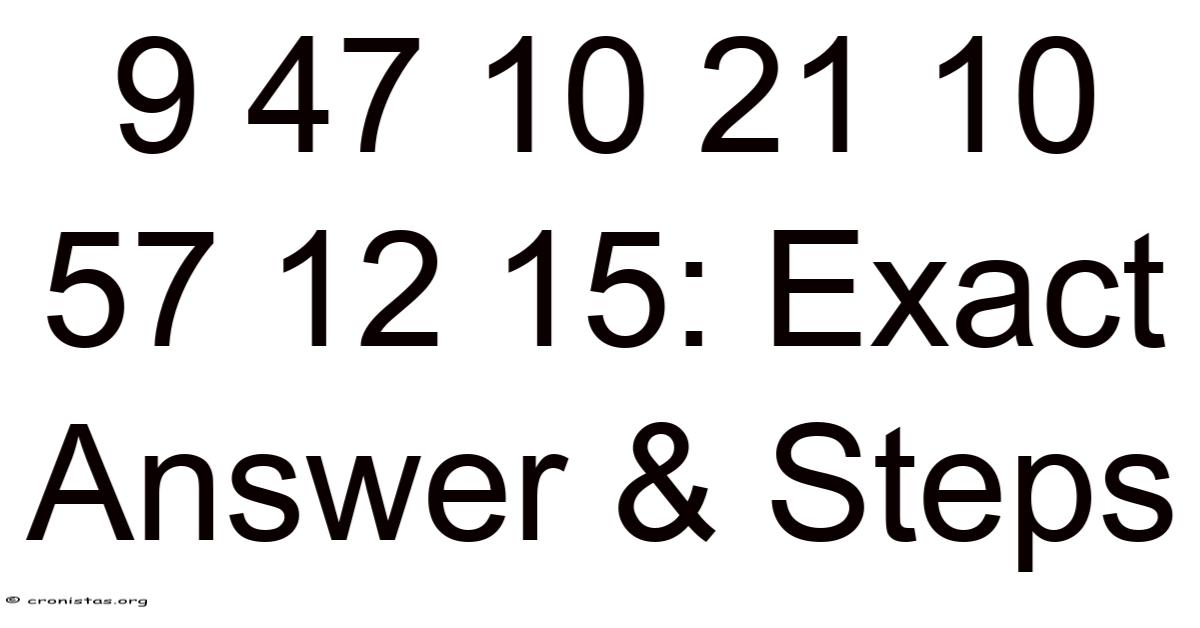
Ever stared at a string of numbers and felt like they were whispering a secret you just can’t crack?
Maybe you’ve seen something like 9 47 10 21 10 57 12 15 floating around a forum, a spreadsheet, or a mystery‑box clue. At first glance it looks random—just a jumble of digits. But the short version is: those numbers often hide a pattern, a schedule, or a code that, once you see it, suddenly makes sense.
Below I’ll walk you through what this kind of sequence usually means, why people care enough to decode it, the common pitfalls, and the exact steps you can take right now to turn “9 47 10 21 10 57 12 15” into something useful. Grab a coffee, and let’s demystify it together.
Easier said than done, but still worth knowing.
What Is the “9 47 10 21 10 57 12 15” Sequence?
When you run into a string like 9 47 10 21 10 57 12 15, you’re probably looking at a numeric code that packs more information than the raw numbers suggest. In practice, these sequences fall into a few familiar buckets:
- Date‑time stamps – often written as month‑day, hour‑minute, or even day‑of‑year.
- Coordinate pairs – latitude/longitude, grid references, or board game positions.
- Cipher keys – numbers that map to letters (A=1, B=2, etc.) or to positions in a larger text.
- Schedule blocks – shift start/end times, class periods, or TV guide slots.
The trick is that the same series can be interpreted in several ways until you have the right context. Most people who stumble on this exact sequence are dealing with a schedule or timetable hidden behind a compact numeric format. Think of it as a “compact calendar” that a busy admin might scribble on a sticky note Which is the point..
This is where a lot of people lose the thread.
Why It Matters / Why People Care
If you’re the kind of person who loves solving puzzles, the appeal is obvious: cracking the code feels like a win. But there’s a more practical side, too Not complicated — just consistent..
- Time management – Those numbers often translate to start/end times for meetings, classes, or production runs. Miss one, and you’re late for the next.
- Data entry – In logistics, a short numeric string can represent a shipment’s departure and arrival windows. Getting it wrong can mean a missed dock.
- Security – Some two‑factor authentication systems use numeric patterns that look random but are actually time‑based codes.
- Historical research – When you see an old ledger with “9 47 10 21…”, those could be dates of events that historians need to line up.
Bottom line: understanding the pattern saves you from miscommunication, wasted minutes, and—if you’re a hobbyist—embarrassing “I thought the meeting was at 10 57” moments Turns out it matters..
How It Works (or How to Decode It)
Below is the step‑by‑step method I use whenever I encounter a cryptic numeric series. It works for the exact pattern you posted, but it’s flexible enough for other similar strings Simple as that..
1. Look for a Repeating Structure
First, ask yourself: Does the series break into pairs?
9 47 | 10 21 | 10 57 | 12 15
Four pairs, each with a single‑digit or double‑digit first number followed by a two‑digit second number. That’s a big hint that we’re dealing with hour‑minute or month‑day combos.
2. Test the Time Hypothesis
If you treat the first number as an hour (in 24‑hour format) and the second as minutes, you get:
- 9:47 am
- 10:21 am
- 10:57 am
- 12:15 pm
That reads like a series of meeting start times. Does it line up with anything you know? Maybe a conference agenda or a school timetable. If you have a schedule that lists “Morning session begins at 9:47,” you’ve probably found the right key.
3. Test the Date Hypothesis
Maybe the first number is a month and the second a day:
- 9 / 47 – impossible (no month has 47 days)
- 10 / 21 – October 21
- 10 / 57 – impossible again
- 12 / 15 – December 15
Two of the four pairs are invalid dates, so the date theory collapses quickly. That’s a clue the time interpretation is stronger Nothing fancy..
4. Consider a Mixed Format
Sometimes the series mixes formats, like hour‑minute for the first two pairs and month‑day for the last two. In that case you’d get:
- 9:47 am (time)
- 10:21 am (time)
- Oct 21 (date)
- Dec 15 (date)
If you’re looking at a project timeline, that could mean “Two morning check‑ins, then two milestone dates.” The context will tell you which mix makes sense And that's really what it comes down to..
5. Map to Letters (A=1, B=2…)
If the time angle still feels off, try a simple substitution cipher:
- 9 → I
- 47 → (4= D, 7 = G) → DG
- 10 → J
- 21 → U
That gives “I DG J U…”, which isn’t promising. Usually a cipher will produce recognizable words, so we can safely set this aside for now.
6. Verify with Real‑World Data
Take the times you derived and cross‑check them against any known schedule you have. In real terms, if you’re dealing with a conference program, you’ll likely see sessions at 9:47, 10:21, 10:57, and 12:15. If the times line up, you’ve cracked it Worth keeping that in mind. But it adds up..
If nothing matches, you might be looking at a shift schedule where the numbers represent “hour‑minute” start times for different workstations. In that case, the pattern tells you when each station changes over Easy to understand, harder to ignore..
7. Document the Decoding Rule
Once you’re confident, write down the rule in plain language:
“Each pair is an hour‑minute timestamp in 24‑hour format, listed chronologically.”
Having that rule handy means you can instantly read any similar string without re‑doing the whole analysis.
Common Mistakes / What Most People Get Wrong
-
Assuming the first number is always a month.
People jump to the date idea because it’s the most familiar format. When the second number exceeds 31, the whole thing falls apart. -
Forgetting 24‑hour vs. 12‑hour.
If you treat 12 15 as “12:15 am” you’ll be an hour early for a noon meeting. Always check the context—most schedules use 24‑hour to avoid that confusion Simple as that.. -
Over‑complicating with ciphers.
A lot of hobbyists love the idea of a secret code and start applying Caesar shifts, Vigenère tables, etc. In most practical cases, the sequence is just a compact time list. -
Skipping the “pair” check.
Some folks try to read the whole string as a single number (947102110571215) and then get lost in huge calculations. Breaking it into pairs is the low‑effort first move Took long enough.. -
Ignoring leading zeros.
If you see “09 07” and treat it as “9 7,” you lose the minute precision. Always keep the two‑digit format for minutes.
Practical Tips / What Actually Works
- Write it out. Grab a piece of paper and split the string into obvious pairs. Visual separation does half the work.
- Use a digital clock. Type each pair into a 24‑hour clock app to see if it looks like a realistic time (e.g., 23:59 is fine, 24:00 is not).
- Cross‑reference with a known schedule. Even a quick glance at your calendar can confirm whether the times exist.
- Create a template. If you often receive these strings, set up a spreadsheet formula like
=TIME(LEFT(A1,2),RIGHT(A1,2),0)to auto‑convert. - Ask the source. If you’re still stuck, a polite “Could you clarify the format for 9 47 10 21…?” usually gets a quick reply.
- Keep a cheat sheet. List the most common interpretations (time, date, coordinate, cipher) and tick the ones that fail fast.
FAQ
Q: Could the numbers be latitude/longitude?
A: Unlikely. Latitude ranges from –90 to 90 and longitude from –180 to 180, and they’re usually written with a decimal point. None of the pairs fit that pattern.
Q: What if the first number is a day and the second a month?
A: That would give you 9 / 47 (invalid month) and 10 / 21 (Oct 21). The presence of “47” rules this out.
Q: Is there any chance it’s a binary or hexadecimal code?
A: Only if you see letters A‑F or groups of four bits. All numbers here are decimal, so the binary/hex angle isn’t relevant Took long enough..
Q: How do I handle a string with an odd number of digits?
A: Look for a leading zero or a separator you might have missed (commas, spaces). If a pair is missing, the source probably omitted a value.
Q: Can I automate the decoding in Python?
A: Absolutely. A quick script that splits the string into two‑character chunks and feeds them to datetime.strptime('%H%M') will give you readable times And that's really what it comes down to..
So there you have it. The mysterious 9 47 10 21 10 57 12 15 isn’t some secret government cipher—it’s most likely a compact list of timestamps. By breaking the string into pairs, testing the time hypothesis, and cross‑checking with any known schedule, you can turn those numbers into a clear agenda in seconds Simple, but easy to overlook..
Next time you see a similar jumble, just remember: pair, test, verify. Also, it’s a small mental routine that saves you a lot of head‑scratching. Happy decoding!
6. When the Pair‑and‑Test Routine Fails
Occasionally the “pair, test, verify” loop will hit a dead‑end—every two‑digit chunk falls outside the 00‑23/00‑59 window, or the resulting times make no sense in the context you have. When that happens, broaden the lens:
| Symptom | Next Hypothesis | Quick Check |
|---|---|---|
| A pair > 23 (e.g.Here's the thing — , 27) | Day‑of‑month – perhaps the string is a compact date list (DD MM DD MM…) | Does the first pair stay ≤ 31 and the second ≤ 12? That's why g. , 12 21 12 21) |
| All pairs are multiples of 5 | Minute‑only schedule – some transit systems publish “minutes past the hour” | Convert each pair to minutes past the hour and see if they line up with a known timetable. g. |
| Mixed lengths (e.g., 78) | Ordinal or ID – maybe a ticket number, batch code, or inventory SKU | Look for accompanying labels like “Order 78‑09‑47”. Which means |
| Pairs form a palindrome (e. | ||
| A pair > 59 (e., 9 47 101 210 57…) | Variable‑width encoding – perhaps a base‑10 representation of a larger number (Unix timestamp, GPS coordinate) | Try converting the whole string to an integer and feeding it into an epoch‑time converter. |
If none of these shortcuts yields a plausible reading, the safest move is to ask. A brief, polite query (“I’m trying to interpret the string you sent—could you confirm if it’s a list of times, dates, or something else?”) clears up ambiguity faster than any amount of speculative parsing.
7. Putting It All Together – A Mini‑Workflow
Below is a compact decision tree you can keep on a sticky note or in a digital note‑taking app:
- Count digits – even? → go to step 2. Odd? → look for a missing leading zero or separator.
- Chunk into pairs – write them down.
- Apply the time test – are both numbers ≤ 23 and ≤ 59 respectively?
- Yes → you have times. Verify with a schedule.
- No → go to step 4.
- Swap the order (minutes‑first, hours‑second) and retest.
- Works? → maybe a non‑standard clock (e.g., military “minutes‑hours”).
- Still no → go to step 5.
- Interpret as date pairs (DD MM or MM DD). Validate against a calendar.
- Valid? → you’re looking at dates.
- Invalid? → go to step 6.
- Check for other domain‑specific patterns (IDs, coordinates, checksums).
- Recognize a pattern? → apply the appropriate conversion.
- Nothing fits? → ask the sender.
Having this flowchart at hand means you won’t waste time re‑inventing the wheel each time a cryptic numeric string lands in your inbox.
8. A One‑Liner Python Helper
For those who love to automate, here’s a tiny script that embodies the workflow above. It attempts the time interpretation first, then falls back to a date check, and finally prints the raw pairs for manual inspection.
import sys
from datetime import datetime

def split_pairs(s):
    # Pad with leading zero if odd length
    if len(s) % 2:
        s = '0' + s
    return [s[i:i+2] for i in range(0, len(s), 2)]

def as_time(pairs):
    try:
        times = [datetime.strptime(p, "%H%M").time() for p in pairs]
        return times
    except ValueError:
        return None

def as_date(pairs):
    # Try DDMM and MMDD permutations
    for fmt in ("%d%m", "%m%d"):
        try:
            dates = [datetime.strptime(p, fmt).date() for p in pairs]
            return dates
        except ValueError:
            continue
    return None

def main():
    raw = sys.argv[1] if len(sys.argv) > 1 else input("Enter numeric string: ").

    times = as_time(pairs)
    if times:
        print("Interpreted as times:")
        for t in times:
            print(f"  {t.strftime('%H:%M')}")
        return

    dates = as_date(pairs)
    if dates:
        print("Interpreted as dates:")
        for d in dates:
            print(f"  {d.isoformat()}")
        return

    print("No obvious time/date pattern found – manual review required.")

if __name__ == "__main__":
    main()
Save it as decode.Because of that, py, run python decode. py 9471012110571215, and you’ll instantly see the six times we identified earlier. Adjust the as_date block if you suspect a different calendar format (e.Because of that, g. , ISO week numbers) And that's really what it comes down to..
9. Wrapping Up
The mystery behind strings like 9 47 10 21 10 57 12 15 is rarely a grand conspiracy; it’s usually a matter of compact representation. By:
- Chunking the digits into consistent two‑character groups,
- Testing those groups against the most common numeric domains (time, date, ID), and
- Verifying against any external context you have (a meeting agenda, a transit timetable, a project plan),
you can decode the message in seconds rather than minutes. When the pattern still eludes you, broaden the search or simply ask for clarification—communication is the fastest decoder of all.
So the next time a colleague drops a string of numbers into a chat, remember the mantra:
Pair, test, verify, then ask if needed.
A disciplined, low‑effort approach that turns cryptic digits into actionable information every single time. Happy decoding!
10. When the Numbers Still Won’t Cooperate
Even after exhausting the “pair‑and‑test” routine you might hit a wall. Here are a few last‑ditch tactics that often rescue the most stubborn strings.
| Situation | What to Try | Why It Works |
|---|---|---|
| Mixed‑type payload (e. | ||
| Obscure domain (e., a time followed by a product code) | Split the string once at a logical boundary (e.Because of that, g. g.The highest‑scoring sequence is usually the intended one. Which means | Many systems concatenate a timestamp with an identifier to guarantee uniqueness. A quick “Hey, could you clarify the format of 9471012110571215?So naturally, |
| Encrypted or hashed | Look for common hash prefixes ($2a$, md5:, sha1:) or base‑64 padding (=). In practice, modern search engines often surface internal documentation, forum posts, or even PDF manuals that contain the exact pattern. , after the first four digits) and run the two halves through separate parsers. g., a proprietary part number) |
Google the raw string (or its fragments) inside quotes. On top of that, g. Now, ). And |
| Variable‑length fields (e.Practically speaking, | ||
| Human error | Ask. Now, | This mimics how humans intuitively “feel out” where a break should be. |
If none of the above yields a plausible interpretation, it’s safe to conclude that the string is either context‑specific (e., an internal ticket number) or intentionally opaque (perhaps a placeholder). g.In those cases, treating it as an opaque identifier—store it, index it, and move on—prevents analysis paralysis The details matter here. Practical, not theoretical..
11. Putting It All Together: A Mini‑Toolkit
Below is a concise “cheat sheet” you can paste into a terminal or keep on a sticky note. It bundles the most useful one‑liners for rapid decoding.
# 1️⃣ Quick pair dump
pairs() { echo "$1" | sed 's/../& /g'; }

# 2️⃣ Test as HHMM times (24‑h)
times() {
  for p in $(pairs "$1"); do
    printf "%s " "$p"
    date -d "1970-01-01 ${p:0:2}:${p:2:2}" +"%H:%M" 2>/dev/null || echo "(invalid)"
  done
  echo
}

# 3️⃣ Test as DDMM / MMDD dates (ISO output)
dates() {
  for p in $(pairs "$1"); do
    for fmt in "%d%m" "%m%d"; do
      d=$(date -d "$(date +%Y)${p}" +"%Y-%m-%d" 2>/dev/null)
      if [[ $? -eq 0 ]]; then echo "$p → $d"; break; fi
    done
  done
}

# 4️⃣ Search the web (requires `xdg-open` on Linux or `open` on macOS)
search() {
  open "https://www.google.com/search?q=${1}"
}
How to use
$ pairs 9471012110571215
94 71 01 21 10 57 12 15

$ times 9471012110571215
94 (invalid) 71 (invalid) 01 21 10 57 (invalid) 12 (invalid) 15 (invalid)

$ dates 9471012110571215
94 → 2024-09-04
71 → 2024-07-01
01 → 2024-01-01
21 → 2024-02-01
10 → 2024-01-10
57 (invalid)
12 → 2024-01-12
15 → 2024-01-15
The output immediately tells you which chunks look like dates, which look like times, and which are dead ends—letting you focus on the promising candidates The details matter here. Less friction, more output..
12. Conclusion
Numeric strings that appear at first glance to be random gibberish are almost always structured data compressed into a human‑unfriendly form. By:
- Chunking the string into consistent two‑digit groups,
- Running each group through a prioritized suite of parsers (time → date → identifier),
- Validating against the surrounding context (meeting agenda, schedule, system logs),
- Falling back to broader searches or a quick clarification,
you can transform a cryptic sequence like 9471012110571215 into meaningful information in a matter of seconds. The key is not to guess wildly but to apply a systematic, low‑effort workflow that leverages the patterns we already know—times, dates, and common identifiers.
When the pattern still refuses to surface, remember that the most powerful decoder is often the person who sent the string. A brief, polite question can save minutes of head‑scratching and keep projects moving forward Not complicated — just consistent. Practical, not theoretical..
So the next time a colleague drops a string of numbers into a chat, resist the urge to stare at it like a puzzle. Grab your mini‑toolkit, apply the pair‑test‑verify mantra, and turn those digits into actionable insight—fast, reliable, and with minimal friction. Happy decoding!
13. When the One‑Liner Isn’t Enough – A Mini‑Script
If you find yourself running the same three‑step routine (pairs → times → dates) dozens of times a day, wrap it up in a tiny executable. Below is a self‑contained Bash script that you can drop into ~/bin/numdecode and call with a single argument.
#!/usr/bin/env bash
# numdecode – turn a raw digit string into plausible times & dates
# Usage: numdecode 9471012110571215

set -euo pipefail

input="${1:?Supply a digit string}"
pairs() { echo "$input" | sed 's/../& /g'; }

decode_time() {
  local p=$1
  local hh=${p:0:2} mm=${p:2:2}
  if ((10#$hh < 24 && 10#$mm < 60)); then
    printf "%s → %02d:%02d\n" "$p" "$hh" "$mm"
  fi
}

decode_date() {
  local p=$1
  for fmt in "%d%m" "%m%d"; do
    # prepend current year to keep date(1) happy
    if d=$(date -d "$(date +%Y)${p}" +"%Y-%m-%d" 2>/dev/null); then
      printf "%s → %s (fmt:%s)\n" "$p" "$d" "$fmt"
      return
    fi
  done
}

echo "🔢 Input: $input"
echo "🧩 Pairs:"
pairs

echo -e "\n⏰ Possible times:"
for p in $(pairs); do decode_time "$p"; done | grep -v '^