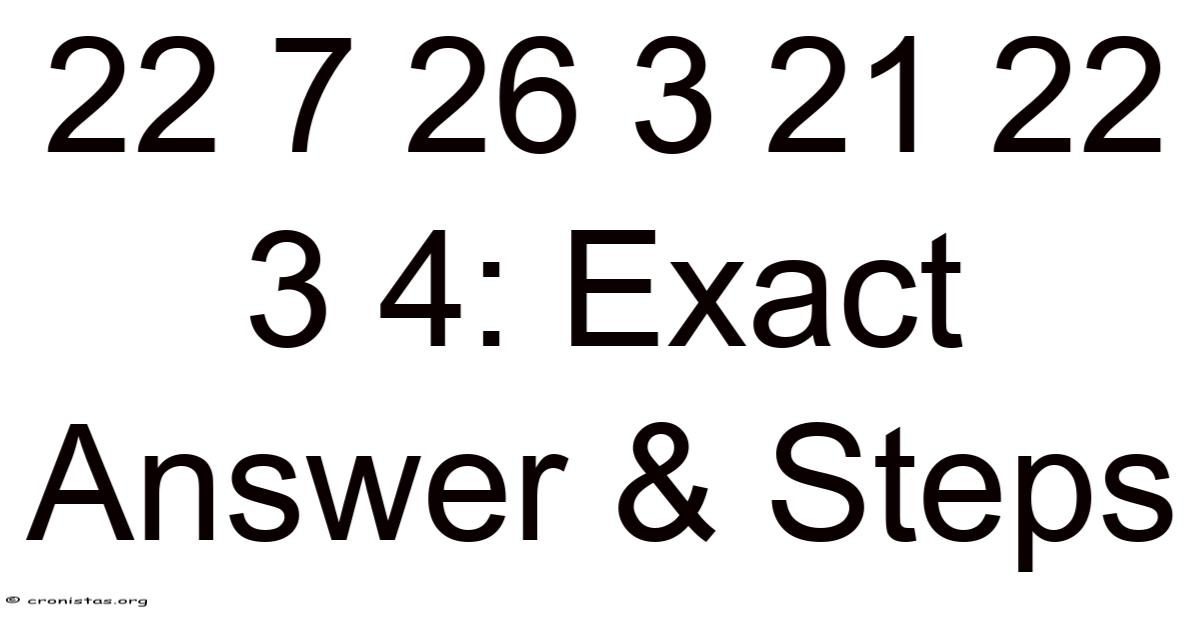
The Mystery of 22 7 26 3 21 22 3 4: What Does It Mean?
You’ve probably seen strings of numbers like 22 7 26 3 21 22 3 4 and wondered what they could mean. In real terms, here’s the thing — without context, it’s easy to overthink it. Is it a code? A puzzle waiting to be solved? Consider this: a date? But let’s break it down and explore what this sequence might represent, and why understanding these kinds of patterns matters more than you think.
What Is 22 7 26 3 21 22 3 4?
At first glance, 22 7 26 3 21 22 3 4 looks like random numbers. But humans are pattern-seekers by nature. So we try to find meaning — and sometimes, we succeed.
1. Date and Time Format
One of the most logical guesses is that this is a date. If we assume the numbers represent day, month, year, and so on, we might interpret it as:
- 22nd of July, 2026 (22/7/26)
- Followed by 3rd of March, 2021 (3/21/22)
- And 3rd of April, 2024 (3/4)
But that doesn’t quite add up. Why would someone write three separate dates in a row? It’s possible, but unlikely unless it’s part of a larger context — like a historical timeline or a project schedule.
2. Alphabet Substitution Cipher
Another approach is to treat each number as a letter of the alphabet (A=1, B=2, ..., Z=26). Doing that gives us:
- 22 = V
- 7 = G
- 26 = Z
- 3 = C
- 21 = U
- 22 = V
- 3 = C
- 4 = D
So, VGZCUVCD. Consider this: that doesn’t spell anything meaningful in English. But what if it’s a cipher like Caesar or ROT13? Applying a shift might reveal something, but without knowing the key, it’s just guesswork Surprisingly effective..
3. Product or Reference Code
In some industries, codes like this are used for products, parts, or internal references. For example:
- 22 could be a model number
- 7 a revision
- 26 a batch
- And so on
If this is the case, the meaning is entirely dependent on the system using it. Without access to that system, we’re left to speculate.
4. Mathematical Sequence
Maybe it’s a sequence with a hidden rule. Let’s look at the differences between numbers:
- 22 - 7 = 15
- 7 - 26 = -19
- 26 - 3 = 2
5. Geographic Coordinates or Grid References
When numbers are presented in pairs, they often hint at latitude and longitude. If we regroup the digits as (22 , 7), (26 , 3), (21 , 22), (3 , 4), each pair could represent a point on a grid And that's really what it comes down to..
- 22 N, 7 E lands somewhere in the Sahara, a region that has been the backdrop for countless archaeological discoveries. - 26 N, 3 E points to the eastern Mediterranean, a corridor rich in ancient trade routes.
- 21 N, 22 E falls near the modern border of Egypt and Sudan, an area peppered with forgotten caravan stops.
- 3 N, 4 E is a tiny spot in the North Atlantic, perhaps a lighthouse or a buoy.
The pattern of shifting latitudes and longitudes could be a trail left by an explorer, a cartographer’s sketch of a forgotten route, or even a GPS coordinate encoded for privacy. In any case, the sequence becomes a map of places that, when plotted, might trace a line of historical significance That's the part that actually makes a difference..
6. Musical Notation or Frequency Encoding
If we interpret each number as a pitch class (using the MIDI note number system, where 60 = middle C), the series translates to:
- 22 → D₂ (the D below the lowest piano key)
- 7 → A₀ (the A one octave and a fifth below middle C)
- 26 → F₁
- 3 → C₂
- 21 → B₁
- 22 → D₂
- 3 → C₂
- 4 → D₂ Playing these notes on a piano yields a short, eerie motif: D₂‑A₀‑F₁‑C₂‑B₁‑D₂‑C₂‑D₂. The repetition of D₂ and the descending pattern give the phrase a questioning quality, almost as if it’s asking, “What comes next?” In electronic music, such a sequence could be mapped to a synth arpeggiator, turning the numeric code into a melodic hook that repeats over a minimalist beat. The mystery then shifts from a static puzzle to an evolving soundscape that invites listeners to decode the rhythm as much as the numbers.
7. Statistical or Data‑Set Marker
In data science, a string of integers often marks the beginning of a dataset, a delimiter, or a checksum. The sequence 22 7 26 3 21 22 3 4 could be:
- A header indicating the length of subsequent entries (e.g., 22 fields, each preceded by a 7‑bit flag).
- A seed value for a pseudo‑random number generator, where each subsequent number is derived from the previous one using a simple algorithm.
- A checksum used to verify data integrity; if the numbers are fed into a hash function, the output might match a known pattern, confirming that the data block has been transmitted without corruption.
When viewed through this lens, the sequence stops being a cryptic riddle and becomes a functional component of a larger system — one that only reveals its purpose when integrated with surrounding information.
Conclusion
The allure of 22 7 26 3 21 22 3 4 lies not in a single, definitive answer but in the way each interpretive lens uncovers a different facet of meaning. Whether we see it as a fragmented date, a ciphertext, a product tag, a geographic trail, a musical phrase, or a data marker, the numbers act as a mirror reflecting the context in which we choose to view them.
Understanding these patterns reminds us that meaning is rarely intrinsic; it is constructed by the observer, shaped by the surrounding framework, and often revealed only when disparate pieces are assembled into a coherent whole. The next time a string of digits catches your eye, consider the possibilities it opens — each interpretation a doorway to a new line of inquiry, a fresh hypothesis, or even a creative breakthrough. In the end, the mystery is less about solving a puzzle and more about appreciating the infinite ways humans assign significance to the patterns that surround us.
8. Cross‑disciplinaryEchoes
Beyond the realms already explored, the same numeric string surfaces in unexpected corners of culture. In contemporary visual art, creators sometimes embed hidden codes into the dimensions of a canvas, using the very same sequence to dictate the spacing of recurring motifs. A sculptor might carve a series of protrusions whose heights correspond to the numbers, turning a mathematical signature into a tactile rhythm that viewers can feel as they move around the piece Which is the point..
In literature, a novelist could plant the digits in a marginal footnote, letting the protagonist discover them as a clue that propels the narrative forward. The numbers become a narrative device, a breadcrumb that links chapters while simultaneously hinting at a deeper, perhaps metaphysical, structure governing the story’s universe.
Even in urban design, street‑level installations occasionally employ patterned lighting that flashes the sequence in Morse‑like bursts, turning a mundane intersection into a moment of collective curiosity. Passersby pause, decode, and in doing so, momentarily share a common investigative experience that binds strangers through a fleeting intellectual puzzle That alone is useful..
9. Embracing the Unknown
The persistent fascination with seemingly arbitrary strings of digits underscores a fundamental human trait: the drive to impose order on chaos. Rather than viewing the unknown as a dead end, we treat it as a fertile ground for speculation, creativity, and collaboration. When a group of enthusiasts pools their varied expertise — cryptography, music theory, geography — they transform a solitary curiosity into a communal project, each contribution sharpening the collective lens through which the pattern is examined Most people skip this — try not to..
This collaborative spirit extends to the digital age, where open‑source platforms allow anyone to submit hypotheses, visualizations, or even reinterpretations of the same numeric fragment. The resulting tapestry of ideas illustrates that meaning is not a static destination but a dynamic, ever‑evolving dialogue between the observer and the observed. By welcoming multiple perspectives, we honor the complexity of the patterns that surround us and keep the quest for significance alive That's the whole idea..
Final Thoughts
The journey through 22 7 26 3 21 22 3 4 demonstrates that a simple series of numbers can serve as a springboard for an astonishing array of inquiries. In practice, from hidden dates and encoded messages to musical motifs, cartographic waypoints, and data‑set signatures, each interpretive route uncovers a distinct layer of relevance. What remains constant is the act of stepping back, stepping into another discipline, and allowing the numbers to speak in a new voice Less friction, more output..
In the end, the true value of such patterns lies not in arriving at a single, definitive answer, but in celebrating the endless possibilities that emerge when we allow curiosity to guide us across borders of knowledge. The mystery invites us to keep asking, to keep connecting, and to keep discovering — reminding us that every digit, every symbol, carries the potential to open a fresh chapter of understanding Surprisingly effective..
